One of the many species of goldenrod. This blooms in late summer - July-September-ish. Although allergies acting up are often blamed on goldenrod, I have it on good authority (wikipedia) that it is not goldenrod pollen causing bad allergies in the late summertime, but more likely Ragweed.
And now you know.
Monday, September 29, 2008


Thursday, September 25, 2008
Small White Wood Aster
Or possibly Calico Aster? I'd say definitely in the Aster family. Maybe.
This blooms in the fall and apparently profusely so. What a glorious bouquet!
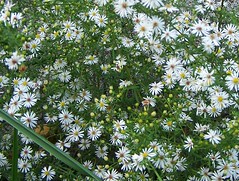
This blooms in the fall and apparently profusely so. What a glorious bouquet!
Monday, September 22, 2008
Sassafras Tree
There are plenty of sassafras trees in these woods. The leaves come in about three shapes: There's the mitten-looking leaf shown here, the spear-shaped leaf and then the mitten-looking leaf with a "thumb" on both sides.
The roots of the sassafras can be dug up and boiled into an aromatic and fine-tasting tea. Unfortunately, ingested in too great amounts, the tea can be carcinogenic, according to recent studies.
However, it is my understanding that once or so a year is not enough to warrant concern.

The roots of the sassafras can be dug up and boiled into an aromatic and fine-tasting tea. Unfortunately, ingested in too great amounts, the tea can be carcinogenic, according to recent studies.
However, it is my understanding that once or so a year is not enough to warrant concern.
Monday, September 8, 2008
Mistflower
The Mist flower is an attractive late season perennial about 3 feet tall with blue flowers. The Mist Flower is also known as Blue Bonnet or Wild Ageratum.
Blooms late summer.

Blooms late summer.
Tall Ironweed
From one source, tall ironweed...
May be a noxious weed or invasive
This plant is attractive to bees, butterflies and/or birds
Self-sows freely; deadhead if you do not want volunteer seedlings next season
This plant is resistant to deer
Blooms late summer.

May be a noxious weed or invasive
This plant is attractive to bees, butterflies and/or birds
Self-sows freely; deadhead if you do not want volunteer seedlings next season
This plant is resistant to deer
Blooms late summer.
Friday, June 20, 2008
Chicory
I've not spotted chicory on the farm yet, but it is an everpresent reality in our part of the world, so I shouldn't be surprised were it to be present there somewhere.
Along with Queen Anne's Lace, Chicory is a frequent roadside weed growing everywhere along highways and in empty urban lots. Some use its roots to make a coffee, or so I'm told.
Chicory blooms its brilliant blue flowers from Mid-May through summer.

Along with Queen Anne's Lace, Chicory is a frequent roadside weed growing everywhere along highways and in empty urban lots. Some use its roots to make a coffee, or so I'm told.
Chicory blooms its brilliant blue flowers from Mid-May through summer.
Tuesday, June 17, 2008
Queen Anne's Lace
I have not spotted Queen Anne's Lace at the farm yet, but it is quite plentiful in the region. This plant (also known as Wild Carrot, as its young root is edible - in the carrot family) is often seen on roadsides beginning in late May in our region, along with the ubiquitous Chicory.
While this is an edible wild plant, extreme caution should always be exercised when eating food you're not sure of. And especially in this case, as Queen Anne's Lace looks quite similar to the deadly poisonous Hemlock.
Once the flower is finished blooming, it folds in upon itself, looking very much like a beautiful birds nest, which explains the common British name of the flower - Birds Nest.
Subscribe to:
Posts (Atom)
